Showing posts with label drawing. Show all posts

Saturday, March 15, 2008

Longing for Picasso?


[Detail of Picasso's drawing of Ruth Dangler, NGA, Washington DC]

WilliePilgrim makes me feel guilty. (It's of course not your fault Willie.) I seem to be always the party pooper here. But I read your column regularly now because you're a nice young girl and because I'm an artist too.

I have seen so many clones of these artist that I am rather biased against them at this juncture in my life. I will admit that the water in "Off the Gaspe" has some interesting qualities. But on balance I find all these photo imitating artists a bit pointless. There's so little understanding of what drawing is, for instance, how it is utterly different from what a photograph does.

A drawing is more like a notation that evokes or describes a visual "thought." And thoughts are such funny things. A thought can be very elaborate, very specific or "filled out." Or it can be most vague and ineluctable. A great artist can make a drawing that is like a sigh ("ahh...") or a shrug or like a bright glance or a keen message. This artist strikes me as being unaware of all that. He is so achingly "modern" wearing it like a Boy Scout merit badge. But he's hardly alone. Ninety percent of "artists" are just like this.

Sigh. One can think that Picasso was a brat. But then modern art makes one almost long for Picasso, a true draughtsman!

Theses comments are in reference to Kimberly Brooks review of the photographic drawings of Ethan Murrow found here at the Huffington Post.

Saturday, March 1, 2008

Degas


When I first realized I wanted to be an artist, it was Degas's drawings that particularly attracted me. I have been looking back at Degas's work lately, rediscovering my love for the dynamism of his images -- noticing things in them I'd not noticed before even after very long acquaintance! It has spurred me to draw a lot. I also find myself wanting to deal with the figure, portraying people in ordinary settings as Degas did and searching out the formal beauties of that.
Years ago I did this copy after Degas of the Woman brushing her hair. Now I am looking at his work again and finding new energy for my own. One thing Degas teaches you is the vitality that comes of freedom. Whatever your eyes notice is fair game.

Thursday, February 28, 2008

the work and ideas behind a painting


I wrote on an earlier blog about the way I had studied Cezanne's Vase de fleurs as a prelude to making my own painting. I also wrote about the creative process. I did a lot of drawing as background for the flower paintings that I make. I am not sure how many such drawings I've made. Some were copies of Paul Cezanne's painting; some, studies from still life set ups.
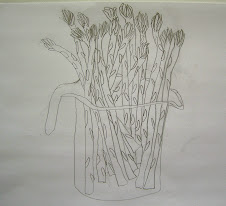
Even in making copies of an old master painting, one finds myriad occasions for invention as can be seen here. I was drawing the same image over and over, yet look how different the various iterations are.

Monday, February 25, 2008

Details


I made studies related to my painting of the flowers. And so, of course, did Cezanne. Above is a detail of a Cezanne watercolor and a pastel detail of a study I did for the painting in the previous post.
Each time you revisit a subject in this way, you see it somewhat differently. All the small spaces have changed. Your attention has changed. Your tools are different and lend themselves to other uses. To redraw the same subject numerous times is itself a form of innovation. {To see some related drawings, click here.)

art of the museums


[Above, vase of flowers by moderationsmuse, vase of flowers by Paul Cezanne]

I visited the museum today to draw. Actually it was my daughter's idea. She drew too. Haven't been there in a while, so it was interesting to reconnect with this once very extremely familiar place. I wasn't there long before visiting a favorite painting of mine by Paul Cezanne.

Some years back I made my own painting that is, in ways, indebted to it. Today I was drawing a small version of Cezanne's great painting, using Derwent drawing pencils (which are actually a form of dense pastel). When you copy a great master's image, you come close to his thoughts. It's rather like having a conversation with him. What you are copying is what he noticed and considered important. He is saying, "notice this, notice that." And a little contemplation of what has been eliminated from the picture, tells you also what he decided to ignore or subordinate. One finds out these lacunae by studying the same motif from life.

While we were there, we saw some copyists at work. One was taking pain-staking long spans of time and concentration to make the most cursory, initial lines of drawing after a Monet landscape of Camille outdoors holding a parasol. Monet had 85% of the painting finished in the time this woman spent carefully trying to sort out the drawing in a very pale ochre wash. If you're going to study old masters, you need to find out something of how they worked. If one isn't confident with drawing, it's better to just have at it anyway, make some mistakes and correct them later in the copy or in other pictures.

However, I don't wish to parody this copyist. She was doing the "traditional" thing. It was heartening to see. In the "art world" she would not be considered an artist at all, would be totally written off as an amateur and daubber. And perhaps she is. Her hesitance before the canvas was not encouraging. But it was delightful seeing her there trying out these gestures of painting.

"Serious" artists have been so frightened off these days by the shame that purportedly attaches to making museum copies, yet it was long the practice of artists -- great artists -- to copy. Rubens made copies of other artists works when in his 50s. Delacroix, Degas, Van Gogh, Matisse and Cezanne were all copyists. What experience have so many artists forsaken in abandoning this unique silent conversation with the past?

It's a timid artist, quite frankly, who is unwilling to go shoulder to shoulder with the great artists of the past. It's an avenue for learning, yes. But it's also a challenge. "Beat this," they say. Or try to equal it. Or come close. Or at least contend as well as you're able.

I really admired the pluck of the reluctant copyist I saw today. No, she is not a real artist most likely. But all that should bother the objective viewer is the fact that no "serious" artists were there to join her.

Well, take that back. One was. I was there with my notebook!

Monday, February 11, 2008


How delightful this reply of yours. You haven't persuaded me! But you make some wonderful points. Let me see if I can be persuasive. I agree that we depend on society -- so, okay, in that sense politics pervades everything. But that isn't a helpful definition of politics -- not if we want to understand distinctions between political parties, or what motivates voters, or even broader questions like different kinds of political order (democracy, oligarchy, monarchy, tyranny, etc.)


Art benefits similarly by some narrowing of definitions. True that formal questions of how things are ordered visually, line, form, color, etc. are part of every kind of design from old master paintings to business cards. But there is a huge difference between your work as a graphic designer, trying to put visual information into the format dictated by your boss or your customer and you making a drawing for no other purpose than to satisfy your curiosity.


"Fine" artists have customers too, of course. Michelangelo had to answer to the Pope. But certainly there is no way that Michelangelo's customer could have dictated anything of the essense of what Michelangelo was doing. On a very high order of skill like that, he's thinking in formal ways that kind of defy rules. The Pope might have said "add more angels" or something, but none of a tampering with subject matter really touches what is happening formally -- and the formal structure underlying the subject matter conveys more of its meaning than people typically realize.


Well, we're not Michelangelos so maybe that doesn't apply to us .... But no. If you just begin looking at something and draw it. After a while you lose yourself in it. Your attention is captured in various ways by what you see and want. You may not know yourself why various features of the world capture your notice and others don't. This is what "art" is really about. Politics has no relevance to it.


The "political" realm of people interacting with each other is separate from this. Granted your being an artist (as I agreed) has political elements, but not the art.Art comes from within the mind, from aspects of the self, from your visual cortex, from degress of skill (or lack of skill) with which you are born -- over which you have practically zero control. Think of Paul Cezanne, French 19th c Impressionist painter. Cezanne's hero was Peter Paul Rubens. Cezanne would spend hours in the Louvre making drawings after Rubens. Rubens is one of the greatest draughtsman the West has ever produced. Cezanne -- not the greatest draughtsman. But Cezanne's not being able to draw like Rubens did not prevent Cezanne from becoming a great artist also. One of art's wonderful mysteries, this sort of thing.


People have private lives. Artists are perhaps more aware of this than others in our politically saturated world. What transpires when you hold a pencil and draw whatever common object catches your notice has nothing to do with society. The pencil, various conventional ideas about art, perhaps the object might all have various tenuous connections with the political -- but not the drawing. The drawing is more like a dialog between you some "reality" "out there."It's an amazing thing.


Shouldn't say this to someone who is tired from working all day in a graphic design studio, but I'll say it anyway. Draw. Pick something of no significance whatever except that its visually appealing for you. Then draw.Nothing could be further from politics. There are no rules for the order in which your senses notice the features of visual reality.