Thursday, February 28, 2008

the work and ideas behind a painting


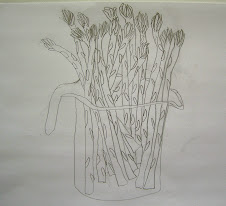
I wrote on an earlier blog about the way I had studied Cezanne's Vase de fleurs as a prelude to making my own painting. I also wrote about the creative process. I did a lot of drawing as background for the flower paintings that I make. I am not sure how many such drawings I've made. Some were copies of Paul Cezanne's painting; some, studies from still life set ups.
Even in making copies of an old master painting, one finds myriad occasions for invention as can be seen here. I was drawing the same image over and over, yet look how different the various iterations are.

Wednesday, February 27, 2008

Daring to be traditional (what ever that is)


I love to draw. Look at the works of artists past, and you find a whole world of things that somebody decided to draw. Some of the subjects fit into categories, by which I mean, that one observes a kind of hierarchy about what things artists were expected to draw (by others), or needed to draw (in order to meet the requirements of their paintings, regardless whether the requirements came from within or without), and things that they drew because other artists had drawn them earlier on and made them iconic.
Among that list of categories, one doesn't have to look long before discovering "drapery." Well, of course you draw drapery so that you can cloth the world. The people in your pictures will be wearing something, and in earlier times the chances were quite good that the something would be rather flowing and formally interesting and complex.
Mme Moitessier, in Ingres's famous portrait, wears the most amazing dress, both in regard to its exquisite floral design as well as for its wonderful folds and forms. The Nike of Samothrace, in turn, showed how in antiquity the figure could be mostly revealed, practically nude, and still require the assistance on innumerable, lyrical and dreamy rippling folds. In mediebal art, even a woman's head dress could provide the occasion for mountainous folds. And for the 19th century still life painter, Paul Cezanne the folds become an end in themselves and will later rematerialize in a new guise as Mont Ste Victoire.
So I draw drapery sometimes. Just because. [drapery study by moderationsmuse]

Being an artist


I've been thinking about some of the cliches associated with art, and contrasting them with lesser known realities. I was just reading Kimberly Brooks blog about the creative process. (Ms. Brooks writes occasional pieces for the Huffington Post.) In this particular blog she talks about having a large canvas sit blank in her studio for several weeks while she tried to summon the bravery to work on it. Finally, to overcome her fears, she randomly applies some bright colors to it. And this much, her "painter's block" and her emotional resolution of it are what many people today would identify as the essential character of creative endeavor. It is one of the cliches.
Cliches such as this one gain force by their repetition and by a generally lax approach to art education -- lax, I mean, on the part of artists. A little research independently done into the process behind truly great works of art reveals a very different sort of process.
To cite one example, the great British landscape painter Joseph Mallord William Turner drew incessantly from childhood onwards. Once he seriously chose to become an artist, he as quickly began angling for ways to sell his works, inspired by his humble circumstances which made earning his keep an urgent necessity. And his marketing efforts found early success, not the least because even his early works showed a remarkable fluency with visual forms. In short, he practiced his art assiduously and became exceedingly skillful at it.
He also apparently felt a reluctance to tackle a large canvas, but for reasons quite different from those typical of today's artists, as Ms. Brook's piece relates. Canvas was expensive and Turner was loath to waste money on material resources. So his early works tend, for the most part, to be small drawings and watercolors. And it was only after Turner had become an accomplished creator of images that he even turned his attention to large painting, and did so for the money, the prestige, and probably also to demonstrate that his skills were as large as those of various famous masters (such as Aelbert Cuyp). When Turner began his first large painting (and it was really large), he did not indulge a case of blocked creativity. Quite the contrary, he worked out the essential elements of the composition in drawings and other small images and then transferred the idea to the larger tableau. The creativity of the project did not reside in staring at a void and trying to imagine something, anything, with which to fill it. The creativity arose from having a motif, a subject, a particular landscape he wished to depict, and then blocking in the large forms of that image onto this new larger format.
His creativity certainly did not end there, as anyone familiar with the painter's works knows. Turner would eventually become renowned for his experimental uses of paint, imagery, and scale. Certainly in his first large scale works he would repeat ideas that had been first developed on a smaller scale. But the artist's sensitivity to the potentialities of scale would readily become a feature of monumental works. In short, he just painted.
The artists that we now call the old masters suffered fewer qualms about making images than do today's artists. They were not unwilling to just paint something. They were aware that, through making images, they were gaining not only sharpened skill, but were gaining experience, sensibility, and new ideas, ideas which they might store away for future things. They did not need to just fill the blank void with anything in the hopes of getting an idea. They had specific aims in mind that they pursued. It's a good lesson for anyone trying to make art today, a lesson in humility as well as daring.

Monday, February 25, 2008

tradition verses life


I used to paint little still lifes of flowers. In recent years, however, my paintings have tended toward hard to categorize images like the "tree" above. I wish I could explain to people why "tradition" is not only important but essential. I also wish I could explain why most times people easily mistake what "tradition" actually is. The idea of the past is so misunderstood that one is hard pressed to know where to begin setting people right about it. Conservative "traditional" artists don't understand the past, and avant garde "edgy" artists don't understand it either (neither do they understand the tyranny of the present).
But necessity is the mother of invention, and I find it nearly impossible to market my "innovative" paintings like the Tree picture. It is not weird enough to suit the hipster crowd, nor familiar enough to be readily understood by a large public. So it, and I with it, fall between the cracks.
Consequently I've been thinking of turning more of my attention to "traditional" subjects -- like vases of flowers again. I can hide as much modernity in them as I like, and still appeal to an audience that wants subject matter to be transparently meaningful.
Sometimes I've wondered if this decision represents a retreat. But I am just beginning to understand the ways in which it's an advance. It's a way into a more modern painting than what I was doing. It is a way of shaking off the last vestiges of "modern art" and just making an art about life (in this case about my life).
And nothing really is more removed from tradition, convention, fashion and so forth than plain ol' life.
"Study life" has always been the credo of the old masters and for good reason. It is the most misunderstood and most profound, most deep and most difficult bit of advice to do!

Details


I made studies related to my painting of the flowers. And so, of course, did Cezanne. Above is a detail of a Cezanne watercolor and a pastel detail of a study I did for the painting in the previous post.
Each time you revisit a subject in this way, you see it somewhat differently. All the small spaces have changed. Your attention has changed. Your tools are different and lend themselves to other uses. To redraw the same subject numerous times is itself a form of innovation. {To see some related drawings, click here.)

art of the museums


[Above, vase of flowers by moderationsmuse, vase of flowers by Paul Cezanne]

I visited the museum today to draw. Actually it was my daughter's idea. She drew too. Haven't been there in a while, so it was interesting to reconnect with this once very extremely familiar place. I wasn't there long before visiting a favorite painting of mine by Paul Cezanne.

Some years back I made my own painting that is, in ways, indebted to it. Today I was drawing a small version of Cezanne's great painting, using Derwent drawing pencils (which are actually a form of dense pastel). When you copy a great master's image, you come close to his thoughts. It's rather like having a conversation with him. What you are copying is what he noticed and considered important. He is saying, "notice this, notice that." And a little contemplation of what has been eliminated from the picture, tells you also what he decided to ignore or subordinate. One finds out these lacunae by studying the same motif from life.

While we were there, we saw some copyists at work. One was taking pain-staking long spans of time and concentration to make the most cursory, initial lines of drawing after a Monet landscape of Camille outdoors holding a parasol. Monet had 85% of the painting finished in the time this woman spent carefully trying to sort out the drawing in a very pale ochre wash. If you're going to study old masters, you need to find out something of how they worked. If one isn't confident with drawing, it's better to just have at it anyway, make some mistakes and correct them later in the copy or in other pictures.

However, I don't wish to parody this copyist. She was doing the "traditional" thing. It was heartening to see. In the "art world" she would not be considered an artist at all, would be totally written off as an amateur and daubber. And perhaps she is. Her hesitance before the canvas was not encouraging. But it was delightful seeing her there trying out these gestures of painting.

"Serious" artists have been so frightened off these days by the shame that purportedly attaches to making museum copies, yet it was long the practice of artists -- great artists -- to copy. Rubens made copies of other artists works when in his 50s. Delacroix, Degas, Van Gogh, Matisse and Cezanne were all copyists. What experience have so many artists forsaken in abandoning this unique silent conversation with the past?

It's a timid artist, quite frankly, who is unwilling to go shoulder to shoulder with the great artists of the past. It's an avenue for learning, yes. But it's also a challenge. "Beat this," they say. Or try to equal it. Or come close. Or at least contend as well as you're able.

I really admired the pluck of the reluctant copyist I saw today. No, she is not a real artist most likely. But all that should bother the objective viewer is the fact that no "serious" artists were there to join her.

Well, take that back. One was. I was there with my notebook!

Saturday, February 23, 2008

New artists


I have been thinking a lot about the new artist, the one who perhaps hasn't been born yet. I am, like Durer, wondering about the art of the future. I am quite certain it is nothing like the stuff being palmed off as "art" today. This real artist who might be a teenager now, or might be a newborn, who is a genuine artist, is not someone who will even be tempted by today's trends (or tomorrow's either), yet the trends will be there to make his or her life difficult.
This artist of the future is more interested in the life before his eyes, has ideas about things that he wants to make tangible.
This artist that I have in mind doesn't really need an education in art since everything worth knowing is plainly visible in the works of great masters -- all their ideas being visual ideas, they are right there to see. However, with a profusion of junk always around, such an artist probably most likely needs encouragement, needs to hear that what he is doing, does matter.
I realize now that this is the person I want to address.